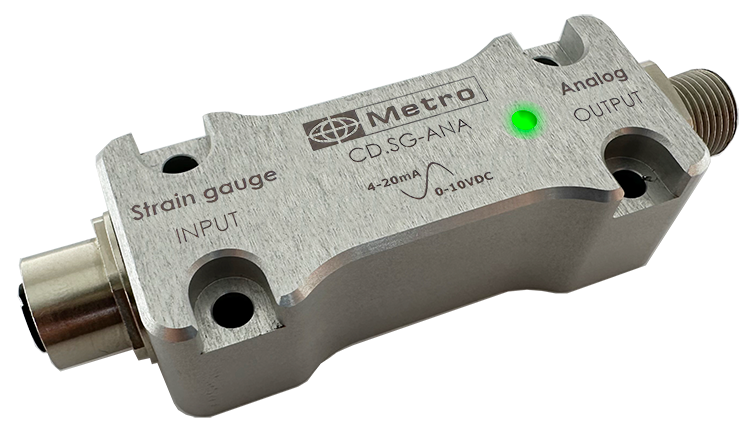
IO-Link signal conditioner
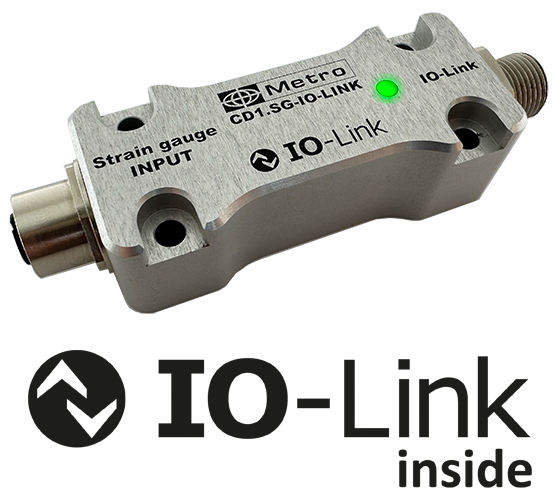
IO Link signal conditioner for strain gauge sensors
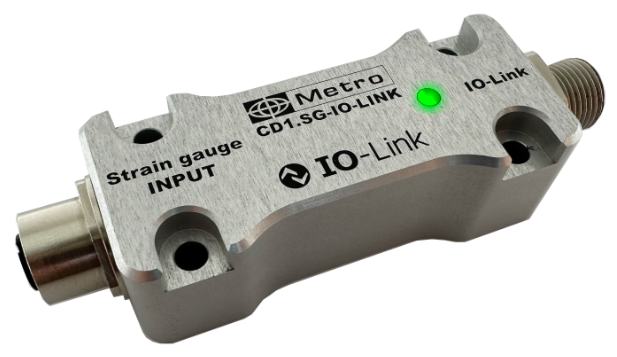
The CD1-SG-IO-Link signal conditioner for strain gauge sensors represents a real evolution compared to traditional amplifiers with analog output (0-10 V, 4-20 mA).
While conventional analog solutions remain limited by issues of accuracy, transmission noise, and configuration complexity, IO-Link is now establishing itself as the new industry communication standard.
Thanks to this point-to-point digital protocol, signals from sensors are transmitted without loss and without the risk of electromagnetic interference, ensuring reliable and repeatable measurements. In addition, IO-Link incorporates numerous features such as remote parameterization and simplified integration into modern automation systems, significantly reducing maintenance costs and improving productivity.
In brief :
- Direct reading and dynamic measurements (peak, etc.)
- 1 input for 4- or 6-wire strain gauge force or torque sensor.
- Accuracy: 0.05% of full scale (CD1-SG-IO-Link only)
- Transmission speed of 230.4 kbaud (COM 3 mode)
- 4800 Hz sampling with several filtering options
- Suitable for use in the most demanding industrial environments, thanks to its machined aluminum housing and electronic design.
- Direct reading and dynamic measurements (peak, etc.)
- 1 input for 4- or 6-wire strain gauge force or torque sensor.
- Accuracy: 0.05% of full scale (CD1-SG-IO-Link only)
- Transmission speed of 230.4 kbaud (COM 3 mode)
- 4800 Hz sampling with several filtering options
- Suitable for use in the most demanding industrial environments, thanks to its machined aluminum housing and electronic design.
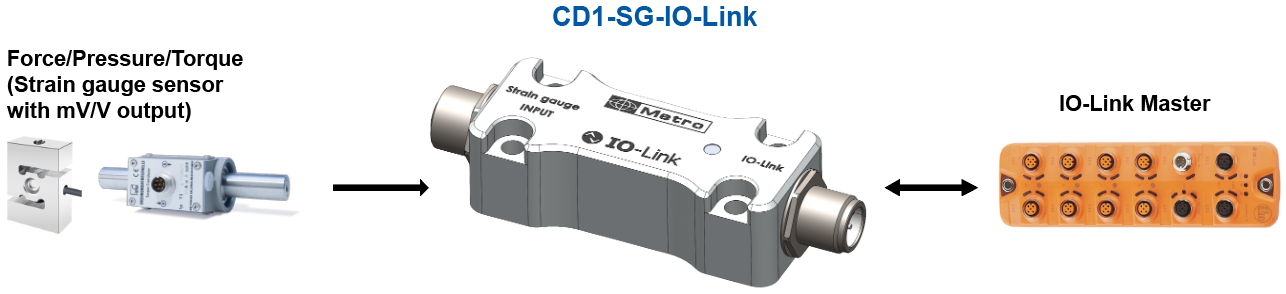
The CD1-SG-IO-LINK is designed in a machined aluminum housing, offering exceptional robustness and an IP67 protection rating, ensuring perfect resistance to harsh industrial environments.
Its installation is simple and flexible: it can be fixed from above using 4 M4 screws, or from below with 4 M5 screws, depending on the mounting constraints.
|
Input type |
4-wire or 6-wire strain gauge |
|
Connectivity |
IO Link side: M12 - 4-pin male |
|
Measurement modes |
Live, Min , Max |
|
Converter resolution |
32 Bits |
|
Sampling rate |
4800Hz |
|
Measurement accuracy |
0,05% Full scale (product only) |
|
|
|
|
Indicator light |
1 LED |
|
Protection rating |
IP67 |
|
Construction |
Machined and anodized aluminum housing |
|
Mounting |
- 4 holes for M4 screws for top mounting |
|
Dimensions |
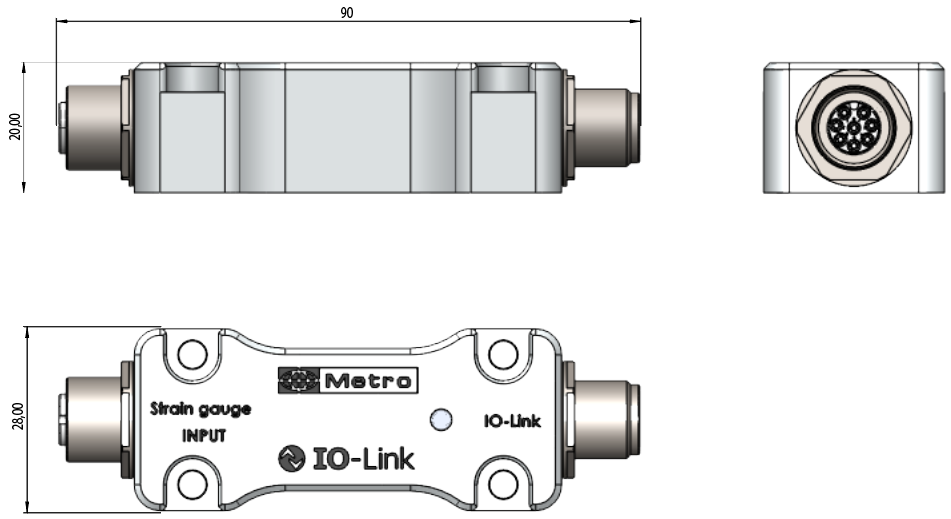
28x90x20 mm, weight 78g |
|
Transmission speed |
COM 3 Mode (230,4 kBaud ) |
|
Minimum cycle time |
1,3ms |
|
Process data inputs (PD In) |
17 bytes :
- live mesure = float 32 Bits = 4 Bytes, - measure Min = float 32 Bits = 4 Bytes, - measure Max = float 32 Bits = 4 Bytes, - Temperature = float 32 Bits = 4 Bytes, - 1 status byte ( < tolerance, OK, > tolerance ) |
|
Parameters |
- Start dynamic measurement |
|
IO Link version |
1.1 |
|
Location |
Yes |
|
Device status |
Yes: |
|
Reset command |
Yes |
Replacing a transducer without reconfiguring the machine.
On an installation fitted with analogue conditioners, changing a force transducer means resetting zero and gain with a potentiometer, then verifying the whole chain. The task ties up a technician and stops the machine.
With the CD1-SG-IO-Link, the transducer parameters are stored digitally and configuration is carried out remotely, from the IO-Link master or the PLC engineering tool. The new transducer is recognised and configured without opening the cabinet, and the machine restarts with exactly the previous setting.
Force measurement in electrically noisy environments.
Close to a motor, a variable speed drive or a welding station, an analogue signal degrades along the cable run. The reading becomes noisy and unstable, and control thresholds have to be widened to avoid false alarms, which effectively means losing sensitivity.
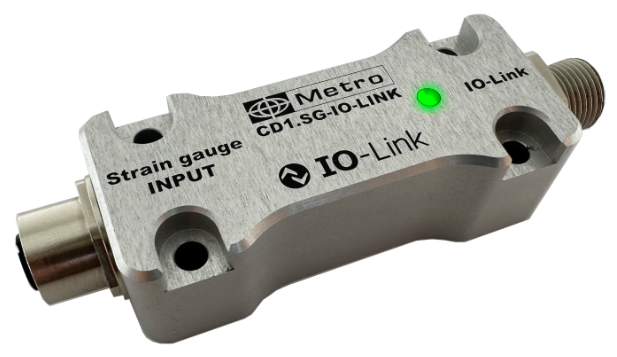
The CD1-SG-IO-Link digitises the reading as close as possible to the transducer and transmits it over a point-to-point digital link. The signal reaches the PLC with no loss and no drift, whatever the cable length, so tight thresholds can be maintained and genuine deviations detected.